Secret of the Raft
Seven years, one play, three ways of building a world.
Secret of the Raft is a bilingual French and English play for ReAction Theatre, built around Géricault’s The Raft of the Medusa. I’ve been building its projected worlds since 2019. Each version used the best tools of its time, so the project reads like a record of how my practice has changed.
The projection has to carry the play’s question without ever saying it.
2026 · AI worlds at the RMIT Black Box
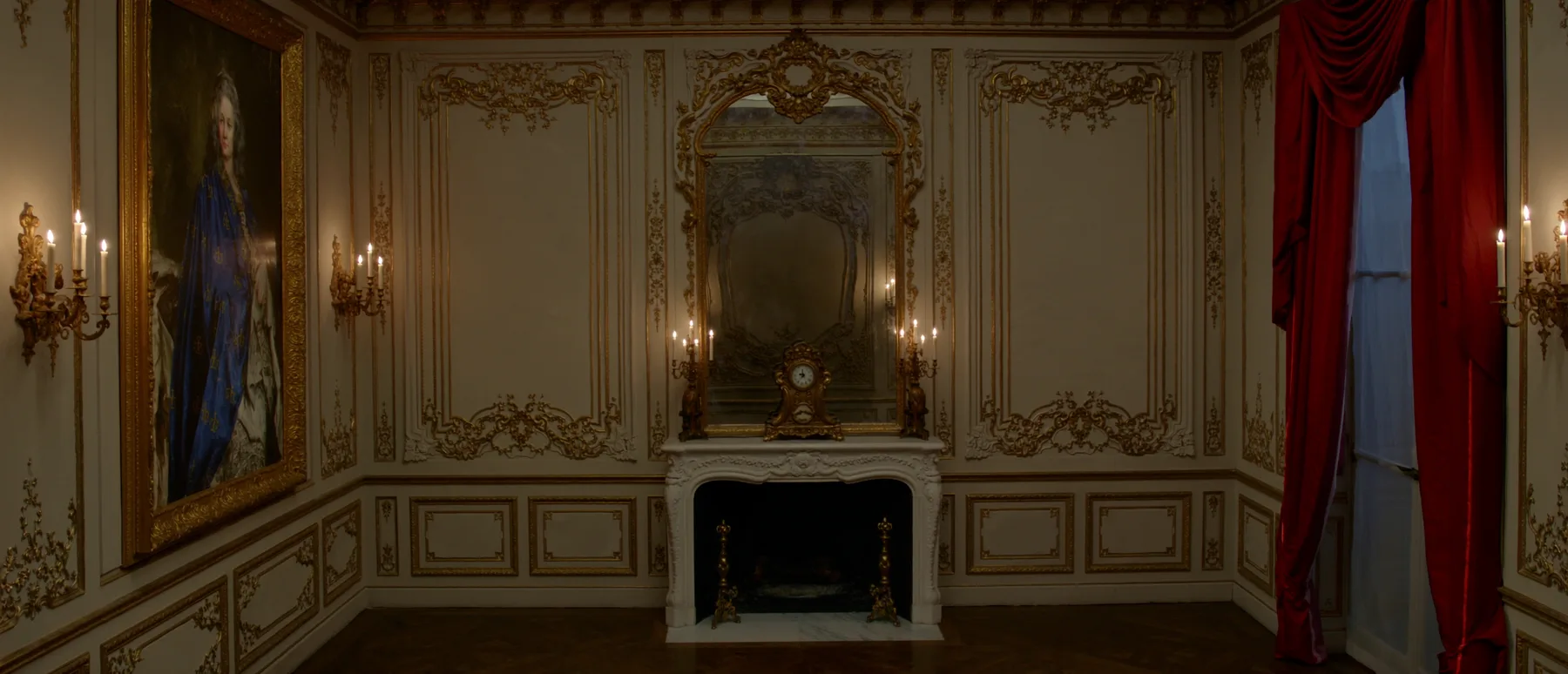
The set is an open book of three surfaces (a 6 m centre wall and two 4.8 m flats splayed at 25°), so every image has to be a real wall of a real room, square-on and at true scale. An actor who walks up to a wall has to stand at the right height against it.
AI models don’t hold a room together on their own, and every generation costs real money. So the work is in the direction, not the prompting: I wrote the rules and the checks first, so the right frame comes out first time, not after dozens of tries.
The process:
- One room master first. A single wide design image of the whole room is approved before any wall is made. It’s never projected. It’s the ground truth that keeps the three walls one room.
- Three locked cameras. Centre, then left, then right, each square-on to its wall, each carrying the room master as its reference. The room’s contents are written once and quoted word for word in all three prompts.
- A check before every generation. References, settings and cost are confirmed before a prompt runs, and every take is logged with what worked. Nothing is generated to find out.
- Loops that move like the real thing. Candle flicker, cloth, burning paper. Every motion has to read as physical.
- Finished in code. About thirty Python tools I wrote with Claude Code handle deflicker, the burning-edge transitions, grading, 4K upscaling and checksummed delivery. The show files go to the operator at 4K, in running order.
2022 · Unreal Engine 5
With Cardinia Shire Council and RMIT School of Design, the team extended the show for a showing at Cardinia Cultural Centre. Pre-production was funded by a Creative Victoria grant in 2020. Illustrations made for the script became references for full-quality scenery built in the newly released Unreal Engine 5.
2019 · Les Mystères du Louvre
The first showing, on 14 September 2019 in the Black Box at RMIT, combined 3D projection mapping, industrial set design and live performance. It’s where the idea started: a famous painting that floods the room around a young audience.
Watch